


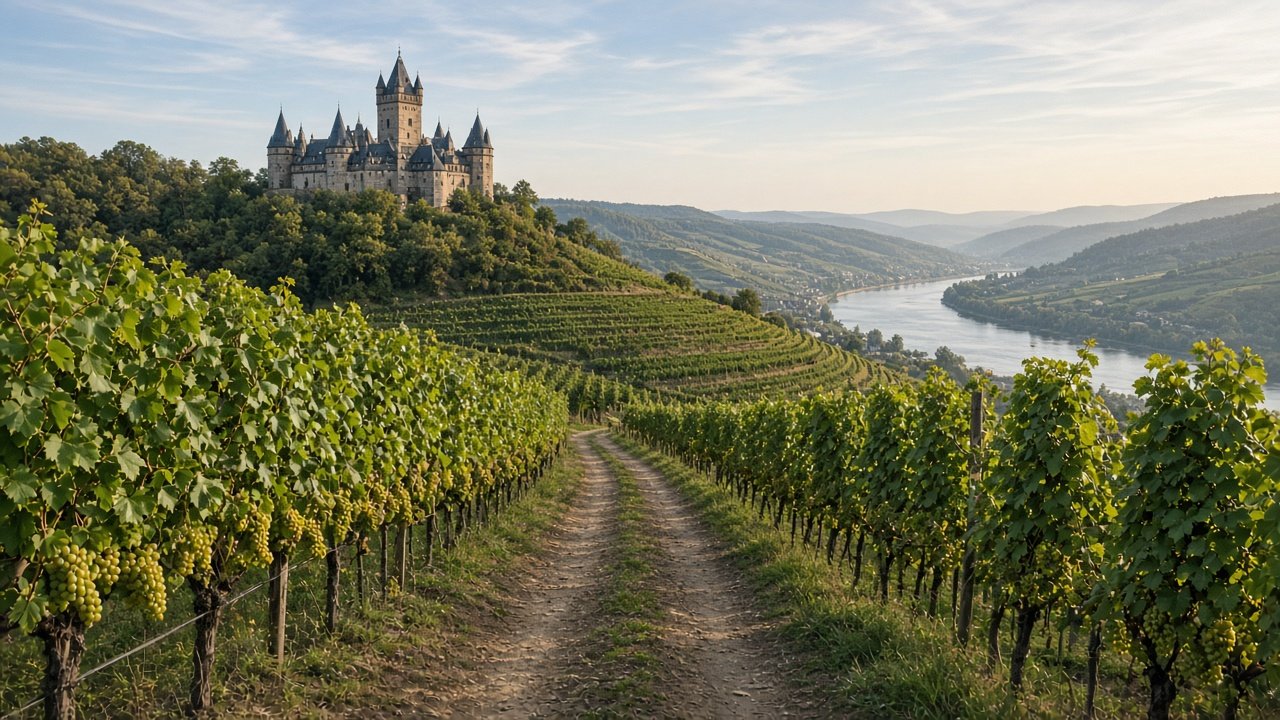
Few places on Earth have as many castles packed into such a short distance as the Middle Rhine Valley. Between Bingen and Koblenz, the river winds for about 65 kilometres through a steep gorge lined with vineyards, half-timbered villages and around 40 castles and ruins. In 2002 this stretch was inscribed as the Upper Middle Rhine Valley UNESCO World Heritage Site.
This guide is part of our guide to castles in Europe. For Germany’s great castles beyond the river, see our guide to medieval castles in Germany.
Most of these castles were built in the Middle Ages to collect tolls from boats on the river, one of Europe’s busiest trade routes. Many were destroyed in the wars of the 17th century, especially by French troops in 1689, and a number were rebuilt in the 19th century by Prussian princes and wealthy industrialists inspired by Romanticism. This guide covers the castles most worth seeing, from south to north, with tips for exploring by boat, train and on foot.
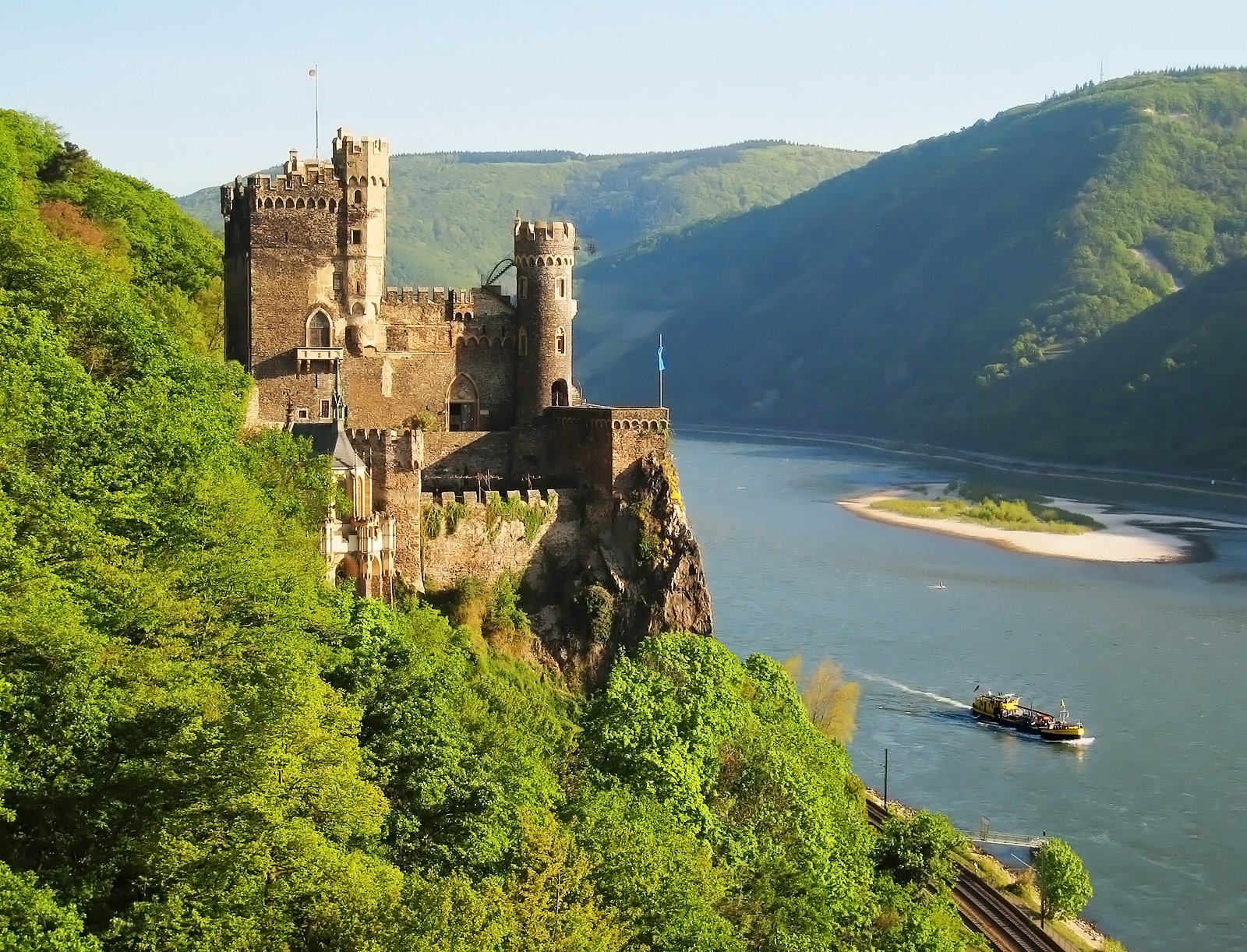
Burg Rheinstein
Near the village of Trechtingshausen, Rheinstein clings to a rocky ledge high above the river. Its origins are medieval, but by the early 19th century it was a ruin. In the 1820s Prince Frederick of Prussia bought it and rebuilt it as a romantic summer residence, making it one of the first Rhine castles restored in the spirit of Romanticism and setting a fashion that spread along the valley. Today it is privately owned and open to visitors, with furnished rooms, a chapel and a pretty Burgundy garden.

Burg Sooneck
A little further downstream near Niederheimbach, Burg Sooneck has a dark early history. In 1282 King Rudolf of Habsburg destroyed it, along with neighbouring Reichenstein, because its lords were notorious “robber barons” who preyed on river traffic. After centuries as a ruin, it was rebuilt in the 1840s by the future King Frederick William IV of Prussia and his brothers as a hunting lodge. It is now cared for by the state and shown on tours.

Kaub: Pfalzgrafenstein and Burg Gutenfels
Pfalzgrafenstein
One of the most unusual castles in Europe, Pfalzgrafenstein sits on a small island in the middle of the Rhine at Kaub, looking like a stone ship anchored in the current. It was built in 1326–27 under Emperor Louis IV (Ludwig the Bavarian) purely to collect tolls. A chain could be stretched across the river, and ships that refused to pay could be held until they did. It was never destroyed and is reached by a small ferry from Kaub in season.
Burg Gutenfels
On the hillside above Kaub stands Burg Gutenfels, a 13th-century castle that, together with Pfalzgrafenstein, controlled the toll station. It successfully resisted a siege in 1504. The castle was later restored and is privately owned, so it is best admired from the town or the river.
Kaub itself is worth a stop: on New Year’s night of 1813–14, Field Marshal Blücher led Prussian and Russian troops across the Rhine here in pursuit of Napoleon’s retreating army, an event remembered in the town’s Blücher Museum.
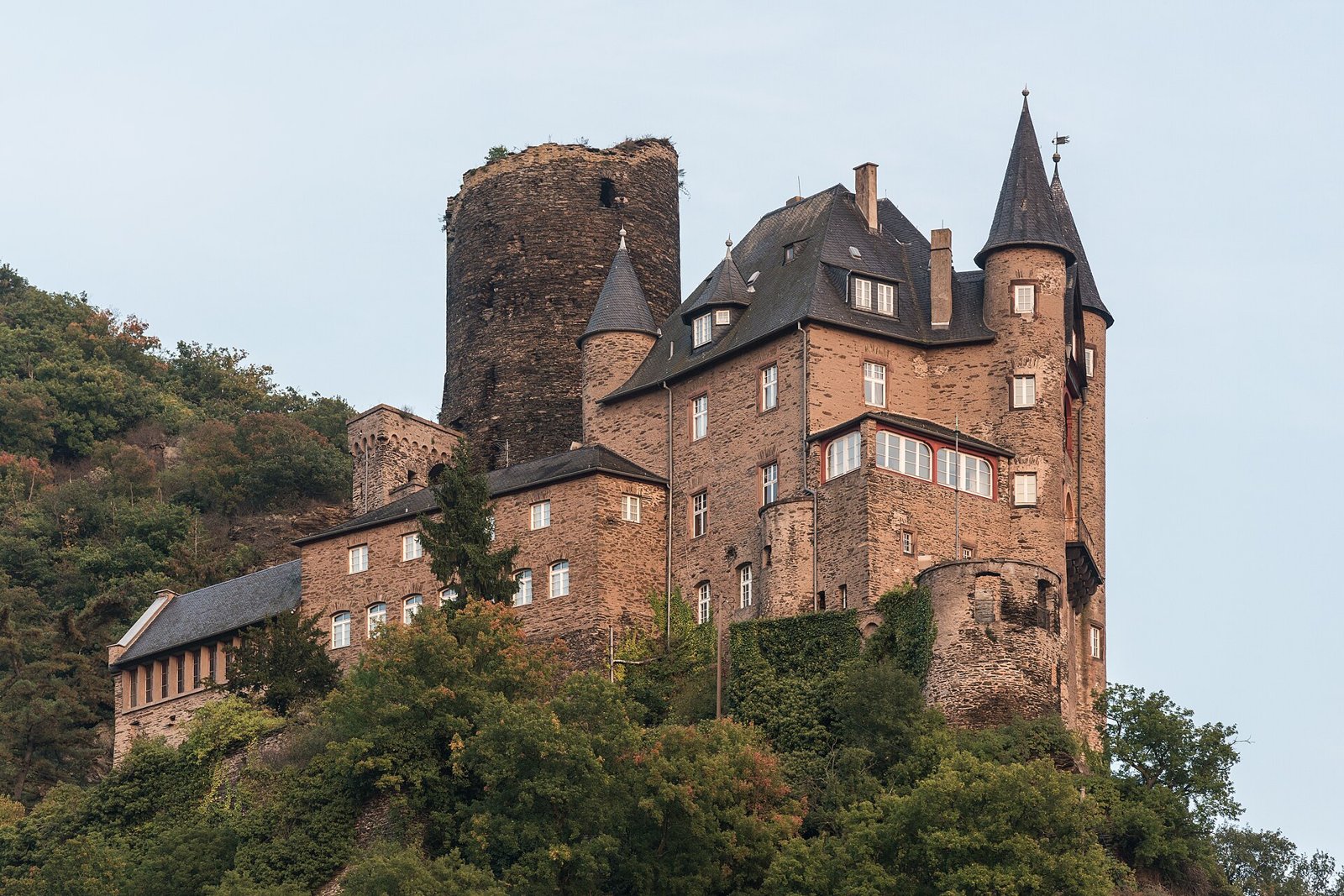
The Loreley and Burg Katz
Just upstream of St. Goarshausen, the river narrows and bends around the Loreley, a 132-metre slate cliff. According to legend, popularised by the poet Heinrich Heine, a beautiful siren sat on the rock combing her golden hair and lured sailors to their deaths in the treacherous waters below.
Above St. Goarshausen, Burg Katz (“Cat Castle”) was built around 1371 by Count Wilhelm II of Katzenelnbogen, whose family name gave the castle its nickname. Downstream sits the smaller Burg Maus (“Mouse Castle”), built by the Archbishop of Trier. The playful names reflect the rivalry between the two powers. Burg Katz was rebuilt in the late 19th century and is privately owned, so it is not open to the public. Across the river, the vast ruins of Burg Rheinfels above St. Goar are open and well worth exploring, including their underground tunnels.
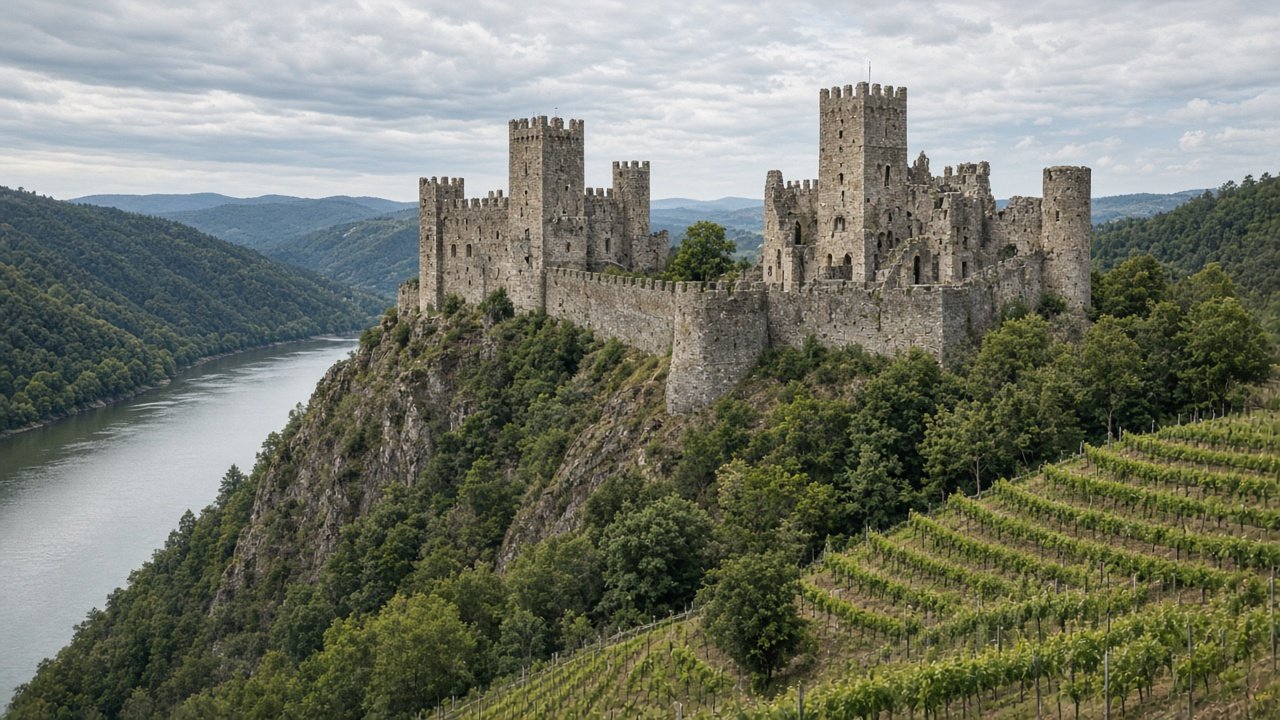
Liebenstein and Sterrenberg: The “Hostile Brothers”
Near Kamp-Bornhofen, two castles stand just a few hundred metres apart on the same ridge, separated by a defensive wall. They are known as the “Feindliche Brüder” (hostile brothers), after a local legend of two brothers who fell out over a woman and ended up living in rival castles glaring at each other. The story is legend, but the setting is striking. Liebenstein houses a small hotel and restaurant, and both castles can be reached on foot from the riverside.
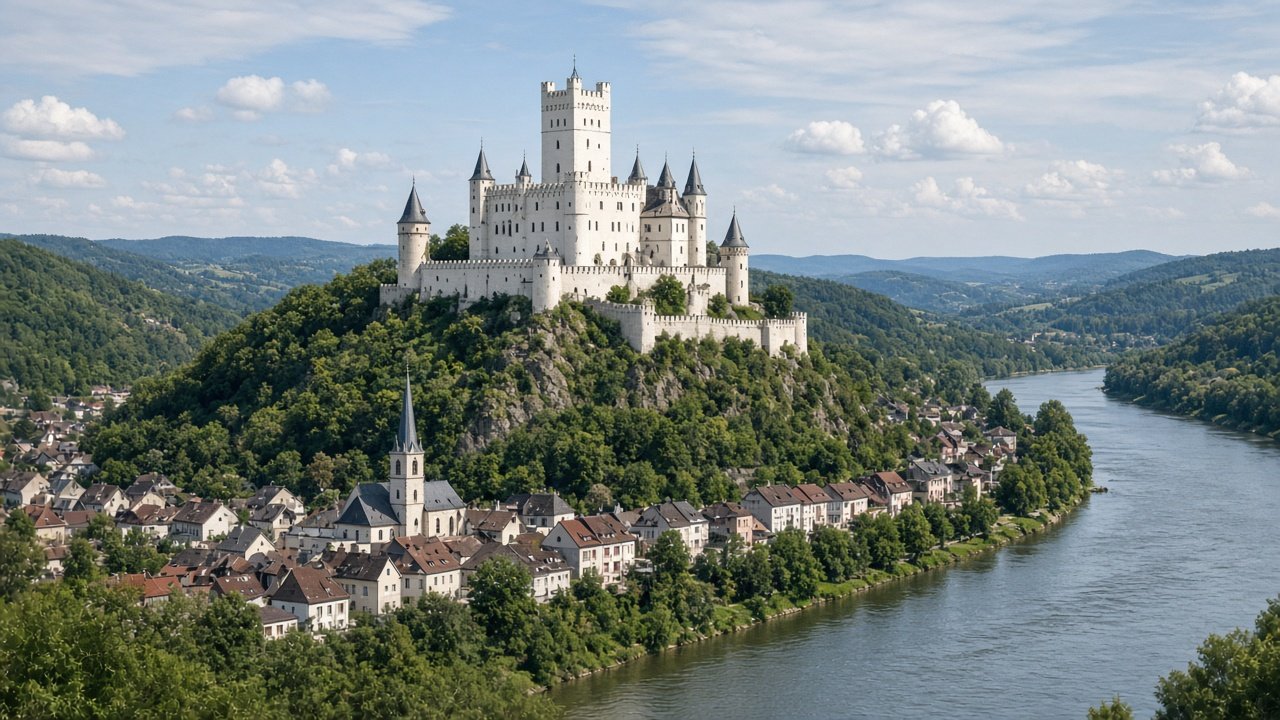
The Marksburg
Above the town of Braubach, the Marksburg is the only hilltop castle on the Middle Rhine that was never destroyed. It is first clearly documented in 1231, and it has survived largely in its medieval form. Since 1900 it has been owned by the German Castles Association (Deutsche Burgenvereinigung), which has its headquarters here. Guided tours take you through the medieval kitchen, the knights’ hall, the armoury and a herb garden, offering one of the most authentic castle experiences in Germany.
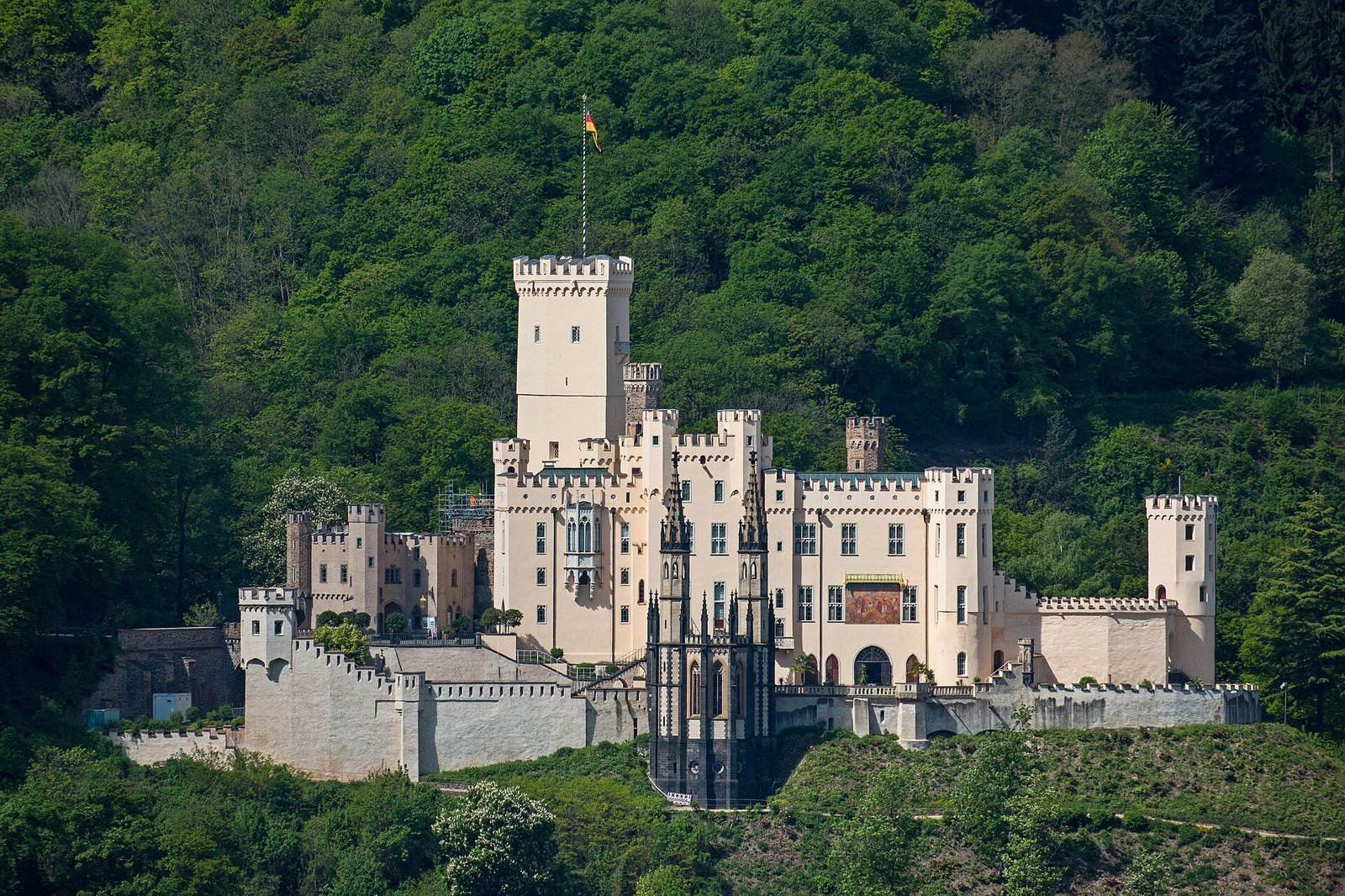
Schloss Stolzenfels
Just south of Koblenz, Stolzenfels began as a 13th-century toll castle belonging to the Archbishops of Trier. It was destroyed by French troops in 1689 and lay in ruins until 1823, when the city of Koblenz gave it to the Prussian crown prince, the future Frederick William IV. He had it rebuilt in the 1830s and 1840s to designs by the famous architect Karl Friedrich Schinkel, creating a jewel of Rhine Romanticism with richly furnished interiors, a chapel and terraced gardens. It is owned by the state of Rhineland-Palatinate and shown on guided tours.
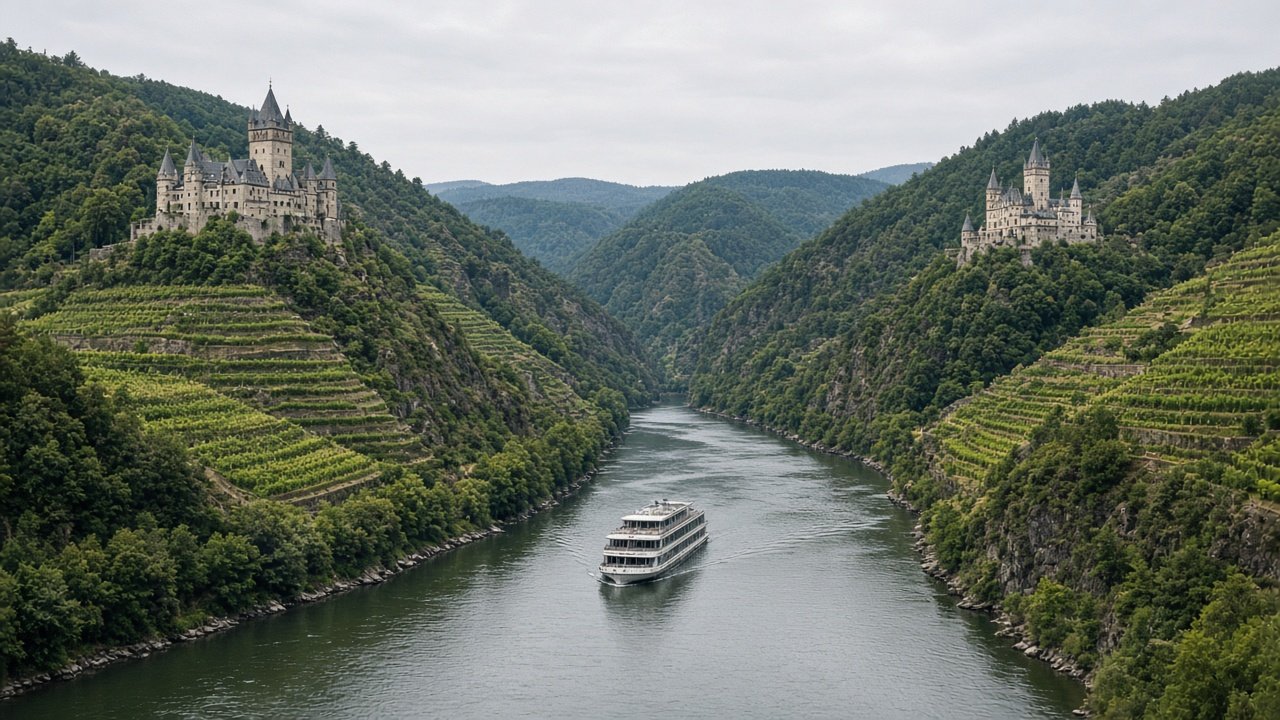
A Perfect One-Day Castle Itinerary
If you only have a day, this plan covers the highlights without rushing:
- Morning: start in Rüdesheim or Bingen and take a boat downstream through the most castle-packed stretch of the gorge, past Rheinstein, Sooneck, Bacharach and Pfalzgrafenstein.
- Late morning: get off at St. Goar and climb to Burg Rheinfels to explore the ruins and tunnels.
- Lunch: eat by the river in St. Goar, with views across to Burg Katz.
- Afternoon: continue by boat or train to Braubach for a guided tour of the Marksburg.
- Evening: carry on to Koblenz, where the Rhine meets the Moselle at the Deutsches Eck, or return by train along the river.
Wine, Villages and Festivals
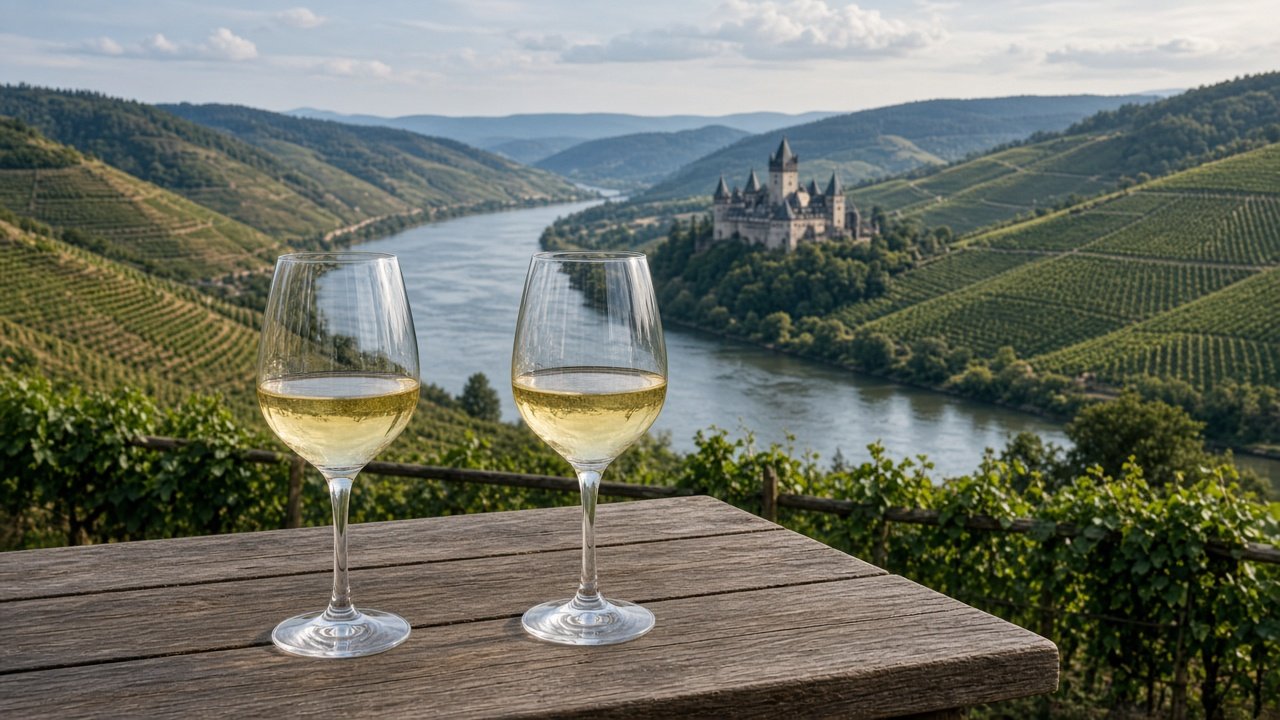
The Middle Rhine is also a wine region, known especially for Riesling grown on steep slate slopes. Many villages, such as Bacharach and Oberwesel, have wine taverns where you can try local vintages, and autumn brings harvest festivals. In Rüdesheim, a cable car carries visitors over the vineyards to the Niederwald Monument, completed in 1883, with sweeping views over the river.
In summer, the “Rhein in Flammen” (Rhine in Flames) events light up several stretches of the river with fireworks and illuminated boat parades on selected nights. They are spectacular but very popular, so book accommodation and boat tickets early if your dates coincide.

Toll Castles and Legends Near Bingen
At the southern gateway to the gorge, around Bingen and Rüdesheim, the castles tell the story that runs through the whole valley: whoever controlled the river could charge every passing ship.
Burg Ehrenfels
On the slopes of the Rüdesheimer Berg, among some of the most famous Riesling vineyards on the Rhine, stand the ruins of Burg Ehrenfels. It was built in the early 13th century and became an important toll castle of the archbishops of Mainz. The castle was destroyed by French troops in 1689 and has been a ruin ever since. It is not open inside, but it is one of the most photographed sights from the river and from the cable car above Rüdesheim.
The Mouse Tower (Mäuseturm)
On a small island just below Bingen stands the slender Mäuseturm. According to a famous legend, the cruel Archbishop Hatto of Mainz refused to help his starving people, fled to the tower, and was eaten alive by mice. In reality the tower was built as a toll and watch tower, and its name may come from Maut, the German word for a toll. It was rebuilt in the 1850s in Gothic Revival style and served for many years as a signal tower guiding ships through the dangerous Bingen rapids.
Lahneck Castle
At the northern end of the gorge, where the Lahn joins the Rhine at Lahnstein, Burg Lahneck was built in the 13th century by the archbishops of Mainz to protect their silver mines and their stretch of the river. It was ruined in the 17th century and rebuilt in the 19th century, when so many Rhine castles were restored as romantic summer homes. Lahneck faces Schloss Stolzenfels across the river, so the two make an easy pair.
Getting Across: Ferries, Not Bridges
There is no road bridge across the Rhine anywhere in the gorge between Mainz and Koblenz, so car and passenger ferries link the two banks, including services between Bingen and Rüdesheim, St. Goar and St. Goarshausen, and Boppard and Filsen. They are frequent, short and part of the fun of a castle tour.
Quick Facts
| Castle | Nearest town | Origins | Notable for | Open to visitors? |
|---|---|---|---|---|
| Burg Rheinstein | Trechtingshausen | Medieval; rebuilt 1820s | Early Romantic restoration | Yes |
| Burg Sooneck | Niederheimbach | Medieval; rebuilt 1840s | Robber-baron history | Yes (tours) |
| Pfalzgrafenstein | Kaub | 1326–27 | Island toll castle | Yes (seasonal ferry) |
| Burg Gutenfels | Kaub | 13th century | Withstood 1504 siege | No (private) |
| Burg Katz | St. Goarshausen | c. 1371 | “Cat and Mouse” rivalry | No (private) |
| Liebenstein / Sterrenberg | Kamp-Bornhofen | Medieval | “Hostile brothers” legend | Grounds; hotel at Liebenstein |
| Marksburg | Braubach | First documented 1231 | Never destroyed | Yes (tours) |
| Schloss Stolzenfels | Koblenz | 13th century; rebuilt 1830s–40s | Schinkel’s Romantic design | Yes (tours) |

How to Explore the Rhine Castles
By boat
A river cruise is the classic way to see the castles. Regular passenger boats run between Mainz, Bingen, Rüdesheim, St. Goar, Boppard and Koblenz in the main season, and you can usually hop on and off. Travelling downstream (north) is faster; upstream is slower but gives you more time to look.
By train
Railway lines run along both banks of the Rhine, stopping at most of the castle towns. Sit on the river side of the train for the best views.
On foot
Two long-distance trails, the Rheinsteig on the east bank and the Rheinburgenweg on the west bank, link many of the castles with spectacular viewpoints. Even a short section, such as the walk up to the Loreley viewpoint, is rewarding.
Where to stay
Bacharach, St. Goar, Boppard and Rüdesheim are all charming bases, and Koblenz and Mainz offer more choice at either end of the valley.
Frequently Asked Questions
How many castles are there on the Rhine?
The Middle Rhine Valley between Bingen and Koblenz alone has around 40 castles and castle ruins.
Which Rhine castle was never destroyed?
The Marksburg above Braubach is the only hilltop castle in the Middle Rhine Valley never to have been destroyed.
What is the best way to see the Rhine castles?
A boat trip between Bingen or Rüdesheim and Koblenz shows the most castles. Combine it with a visit inside one or two, such as the Marksburg or Rheinfels.
Why are there so many castles on the Rhine?
Medieval lords built them to control and tax river traffic. Each territory along the river wanted its own toll station.
When is the best time to visit the Rhine Valley?
From May to early October, when boats run frequently and castles are open. Autumn brings the wine harvest and festivals in the riverside villages.
Are there bridges over the Rhine in the castle valley?
No. There is no road bridge in the Rhine gorge between Mainz and Koblenz, so ferries carry cars, cyclists and foot passengers between the two banks at several points, including Bingen–Rüdesheim and St. Goar–St. Goarshausen.
What is the Mouse Tower on the Rhine?
The Mäuseturm is a small medieval toll and watch tower on an island near Bingen. A legend says Archbishop Hatto of Mainz was eaten by mice there, but the tower was really built to control river traffic. It was rebuilt in the 1850s and later used as a signal tower for shipping.